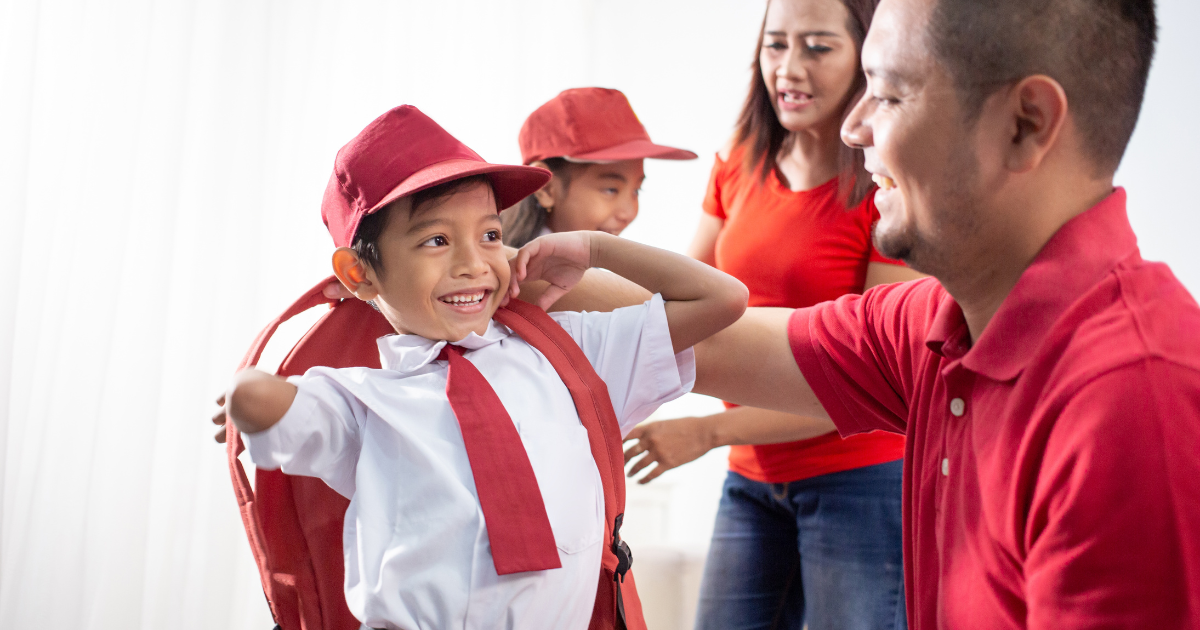
Now that your child has come of age, it’s time to start preschool. It’s a big milestone for both you and your child as learning to spend time apart in a different environment with lots of other kids can be a difficult transition. However, introducing your child to formal education and experiencing schedule and structure is an exciting journey too. Here are 11 ways to help your child make the transition to preschool a smooth one.
1: Start with a Positive Attitude
Although you may have questions and worries, express excitement and positivity about your child’s new adventure. Your enthusiasm about their upcoming preschool experience will rub off on them. Use positive language when discussing preschool, and emphasize the fun and friends they will make.
2: Visit Together
Introduce your child to the new environment before their first day. If possible, plan to go to your child’s new school together to show him around. Play on the playground together, explore the school and classroom and meet the teachers. This way, when they start on day one, school will be a familiar place.
3: Read Together
Reading is a wonderful way to prepare your child for preschool. Share books and stories together, especially about going to preschool. Reading fosters language development and a love for learning. There are quite a number of children’s books about going to preschool such as “I love you all day long” by Francesca Rusackas, “Maisy goes to preschool” by Lucy Cousins,” and “What to expect at preschool” by Heidi Murkoff. These books and others can be bought online through Open Trolley and Book Delivery in Malaysia.
4: Get Social
Arrange playdates with other children to help your child become more accustomed to social interactions. In fact, if possible, arrange a playdate with children from your child’s class. This will allow them to get to know each other before school starts.
5: Prepare a Preschool Routine
Preschool often follows a structured daily routine. To prepare your child, establish a similar routine at home. This can include regular meal times, playtime, and nap time schedules. Consistency helps children feel secure and prepared for the structure of school.
7: Play School together at Home
You can also use pretend play to help your child get used to the idea of preschool. Take turns acting out different routines like story time, singing songs and bedtime. You can also switch up the roles and let your child be the teacher. This will help your child think of school as a fun place and reduce anxiety on day one.
6: Practice a New Home Schedule
Start practicing the new bedtime and wake-up time your child will need for preschool several weeks before school actually starts. Pick a bedtime that will provide a good night’s rest and a wake-up time early enough so neither of you will have to rush in the morning. This will give both of you time to adjust. If you are able, you could even start a new tradition of picking out clothes together the night before school and eating breakfast together in the morning.
7: Learn taking Turns and Sharing
One thing about playing with other children is to learn to take turns and share. Children at 3 ½ years or 4 years old are not used to sharing toys and taking turns. This is something they will learn at preschool but you can give them a head start at learning these social skills at home. Some of them may have an older sibling they can practice sharing and taking turns with. The general rule is: If the toy is in someone else’s hands, it means they are playing with it. Your child can offer the other child another toy (preferably something that they like) and ask (with words) if they would like to swap. If they say no, then your child would have to learn to wait until the other child is finished with it to have a turn.
8: Foster Independence
Encourage your child to become more independent by allowing them to dress themselves, use the restroom on their own, and pick up their toys. Children should be toilet-trained by this time. Let him practice fastening buttons and zippers, putting on his sock and shoes and taking them off. These self-help skills will boost their confidence and make them feel more comfortable in a school environment.
9: Listen to your child
Although it’s tempting to quickly reassure your child and move on, it’s important to let them know that their worries have been heard. No matter what they are, big or small, children’s worries about preschool can significantly influence their experience there. Ask your child about their feelings about starting school and reassure them that it is normal to feel excited, happy, worried, sad or any other emotion. Starting something new can feel scary and big but it can also be lots of fun! Reassure your child that you will be there to pick them up at the end of the day and talk about what those routines will look like too.
10. Label Belongings
Label your child’s belongings such as backpacks, lunchboxes and clothing items. This will help them identify their items and instil a sense of responsibility.
11: Have a Good-Bye Plan
Saying goodbye can be difficult for both you and your child. When that time comes, try to keep your parting quick and positive. Be prepared for a mix of emotions from your child. Some may be excited, while others may feel a bit anxious. Remember that separation anxiety is a common part of the transition. Do reassure your child that you will see each other again soon. You can even have a special routine that will help comfort your child before you go such as singing a song together or doing a special handshake.
Morinaga Chil-kid
Introducing Morinaga Chil-kid 4, the nutrient-dense, growing up milk for preschoolers aged 3+ to school children aged 9. Like Chil-kid 3 formulated for children aged 1 to 3, Chil-kid 4 features 45 carefully-balanced nutrients such as ARA and DHA, Inositol, GOS, 5 Nucleotides, Omega 3&6 Long-Chain Polyunsaturated Fatty Acids (LCPs) and 21 Vitamins and Minerals.
Chil-kid 4
Children in the 3+-9-years age group are in their Golden Age of Growth. They need more energy and nutrients for learning, bone growth, and immunity. Through its increased DHA, ARA, Protein, Calcium, Phosphorus and Vitamin D content, Chil-kid 4 builds on the foundational nutrients provided by Chil-kid 3 which are for immunity, brain, eye and gut development in the toddler age. For preschool to school aged children, Chil-kid 4 fuels continued brain development, builds strong bones and teeth and provides sustained energy for bone development, focus and learning performance.
There is a strong focus on Calcium and Vitamin D in Chil-kid 4 because it has been found by the Malaysian Ministry of Health and SEANUTS[1] that a high percentage of children have insufficient Calcium and Vitamin D intake. Insufficient Calcium and Vitamin D intake reduces calcium absorption and weakens bone growth. Chil-kid 4 addresses this with higher Calcium and Vitamin D levels compared to Chil-kid 3.
Chil-kid 3 and 4
Both Chil-kid 3 and 4 do not contain Sucrose to help reduce sugar intake and are specially formulated for Asian children according to their respective ages and nutritional needs.
Dissolving easily in warm water, Morinaga Chil-kid, which features a mild vanilla flavour, takes the stress and time out of the preparation. Just two to three servings a day alongside meals helps your children meet their Recommended Nutrient Intake (RNI). This means they will not be short of any nutrients they may need for their daily development and growth.
Morinaga Chil-kid is the result of over 100 years of child nutrition research by Japanese scientists. The focus is on how nutrition supports immune health, brain health, physical growth and cognitive development. Everything in the formulation is backed by research and all nutrient combinations are tested and refined by the Morinaga R&D Institute in Japan.
Wholly produced from dairy farms to the packaging process in a state-of-the-art plant in the Netherlands, both milk formulas go through rigorous European Union (EU) quality control as well as a double inspection process with samples sent to Japan for a second inspection before they are shipped to Malaysia.