Congratulations on your pregnancy! You must be very excited that you are now a mom-to-be. Like all expectant mothers, you have many questions and concerns but your main one is on how to ensure yours and your little one’s health. You want to have a safe and healthy pregnancy and one of the ways to ensure that is by making the right nutritional choices. Drinking maternal milk to supplement your diet is one way to see that your nutritional needs are met, should your diet be lacking. Not only will you be supporting your own health needs, your little one will also be relying on you to provide the right balance of nutrients to help him or her grow and develop properly.
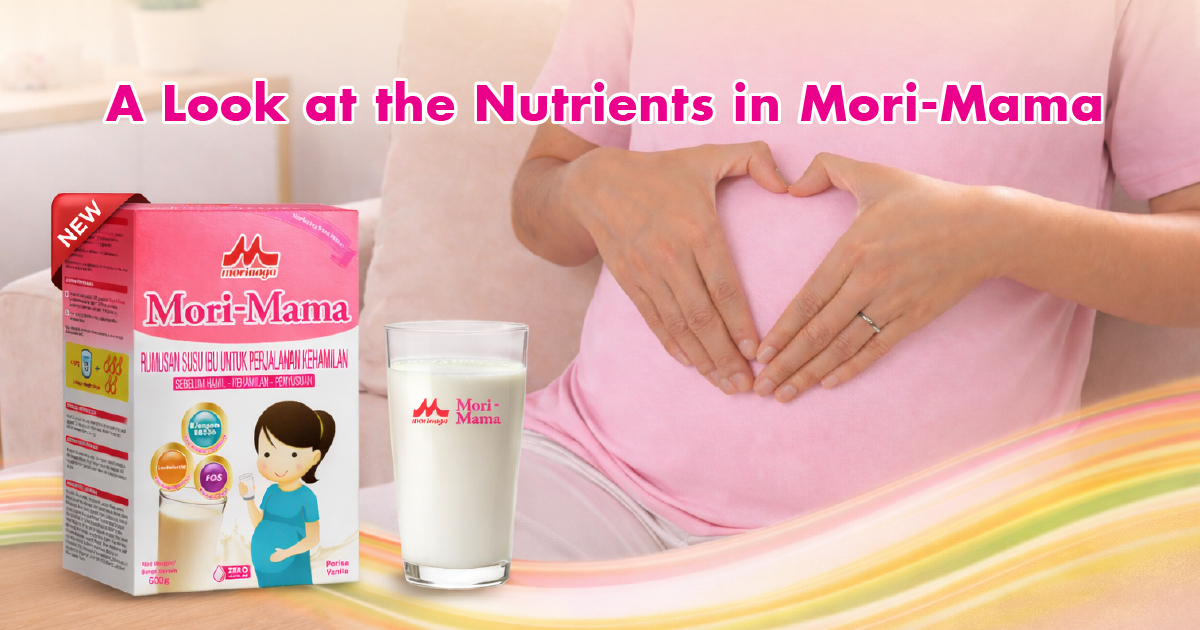
As your pregnancy progresses, you will have increased nutritional requirements due to the demands on the body as it changes to nurture your growing little one. To provide for these requirements, Mori-Mama, Morinaga’s advanced maternal milk formula comes fortified with over 41 nutrients such as lactoferrin, live cultures of probiotics Bifidobacterium longum BB536 and prebiotics FOS (Synbiotic B. longum BB536+ FOS), iron, folic acid, Vitamin A, Vitamin D3, Vitamins B1, B2, B3, B6, and B12, DHA and ALA, calcium, choline and many others.
All of these nutrients have been carefully formulated to support your pregnancy journey in the months to come. Here is a closer look at how some of these nutrients work to support your pregnancy.
Lactoferrin
Lactoferrin[1] is a naturally-occurring, multifunctional, iron-binding protein found abundantly in breast milk. Lactoferrin is crucial during pregnancy for enhancing iron absorption without gastrointestinal side effects. Many women enter pregnancy with low iron counts. Lactoferrin manages iron-deficiency anaemia[2] and also acts as a natural antimicrobial agent, boosts the immune system, and helps maintain a healthy microbiota which protects against infections like urinary tract infections (UTIs). It also protects foetal membranes to support healthy gestation.
Lactoferrin is likened to an “iron bus”. It binds to iron, protects it from stomach acids and transports it to the organs for effective absorption. In so doing, it prevents low iron levels in the body and anaemia. Anaemia[3] is a condition where low red blood cell counts reduce oxygen delivery to the organs, often causing fatigue, weakness, palpitations, sleep difficulties and pale skin for the mother. Anaemia is common during pregnancy due to increased blood volume, which rises to 40% to 50%[4] in the body between 32 and 36 weeks. Severe cases of low iron levels can increase risks of preterm birth, low birth weight, postpartum infection and poor cognitive development in children.
Apart from preventing low iron levels and anaemia for the mother, lactoferrin also maintains healthy iron levels for the little one at birth which is crucial for the child’s optimal development and growth later on.
Iron
Iron[5] is an essential mineral crucial for growth, development, and overall cellular function. Its primary role is to produce haemoglobin[6] (a protein in red blood cells that transports oxygen from the lungs to tissues) and myoglobin[7] (a protein that provides oxygen to muscles). Iron is also necessary for creating certain hormones and maintaining a healthy immune system.
Iron is critical during pregnancy as it has to support a 50% increase in blood volume, supplying oxygen to both the foetus and placenta, particularly during the third trimester. It prevents maternal anaemia, reduces risks of preterm birth and low birth weight, and supports foetal brain development.
Lactoferrin and Iron
To support adequate iron levels for pregnant moms, Mori-Mama delivers 22 mg of lactoferrin per serving, and 10 mg of iron per serving ― the highest among all the other milk brands in Malaysia.
Bifidobacterium longum BB536
Gut health is very important during pregnancy because the mother’s gut microbiome directly supports nutrient absorption and regulates maternal immunity.
To optimise gut health for the mother, Mori-Mama contains Bifidobacterium longum BB536 (B. longum BB536). B. longum BB536 is a Human Residential Bifidobacterium (HRB) probiotic strain that naturally inhabits and is adapted to the human gut. HRB strains such as B. longum BB536 is distinguished from non-HRB species that originate from animals or the environment which are temporary and unstable in the human gut.
Researched and isolated by Morinaga Probiotics Centre, B. longum BB536 has a long history of being well-established and clinically proven[8]. When taken during pregnancy, it improves maternal gut health, modulates the immune system, and contributes to the healthy development of the child’s microbiota.
Mori-Mama is the only maternal milk in the market that contains the live HRB probiotic B. longum BB536 and delivers 1.3 billion CFU of the probiotic per serving.
Synbiotic B.longum BB536 and FOS
Mori-Mama also contains the prebiotic Fructo-Oligosaccharides (FOS) to feed the live cultures of B. longum BB536. FOS helps B. longum BB536 to survive better, grow and function more effectively in the gut. Together, the probiotic B.longum BB536 and prebiotic FOS work in a synergistic manner, creating a synbiotic effect to support healthy digestion and enhance nutrient absorption.
For mothers having constipation, Synbiotic B.longum BB536 and FOS will ease constipation as the synbiotic promotes softer, more regular bowel movements and reduce bloating. Aside from boosting the immune system, Synbiotic B.longum BB536 and FOS also promotes a healthy, balanced gut microbiome that is passed on to the child during birth and through lactation which can aid the little one’s immune development and reduce the risk of allergies and eczema in early life.
Folic Acid
Folic acid is actually Vitamin B9. Folic acid[9] is especially important during early pregnancy because it helps the embryonic neural tube ― which becomes the brain and spine ― develop and close properly. Folic acid has been shown to help prevent serious birth defects called neural tube defects or NTDs. NTDs are major birth abnormalities of the child’s brain, such as anencephaly (incomplete brain/skull development), and spine, such as spina bifida (spinal cord fails to close). NTDs happen in the first few weeks of pregnancy. That is why it is important to take folic acid before conceiving to prevent NTDs which occur within the first month of pregnancy — often before a woman knows she is pregnant. Mori-Mama delivers 347 µg of folic acid per serving ― the highest among all the other milk brands in Malaysia.
DHA and ALA
DHA (Docosahexaenoic acid) and ALA (Alpha-linolenic acid)[10] are essential omega-3 fatty acids crucial for health. Both are especially needed during pregnancy for foetal brain and eye development, particularly in the third trimester. Apart from improving cognitive and visual development in the child DHA supports longer gestation and reduces the risk of preterm birth. DHA also benefits maternal health by potentially lowering the risk of postpartum depression.
ALA is needed during pregnancy for foetal development, particularly for building brain and retina tissue by converting into DHA and EPA (Eicosapentaenoic acid). It promotes healthy birth weight, reduces inflammation, and stabilises maternal mental health.
Choline
You may not have heard of choline[11] before but it is an essential nutrient, often grouped with B vitamins, that is necessary for brain health, nerve function, muscle movement, and liver metabolism. It acts as a precursor to acetylcholine, a key neurotransmitter for memory and muscle control. While the liver produces small amounts, humans must consume choline through diet (eggs, meat, fish, vegetables) or supplements to avoid deficiency.
During pregnancy, the demand for choline significantly increases[12] as it is involved in vital processes such as neural tube formation, brain development, and the synthesis of lipoproteins. It is also essential to keep your liver healthy and your metabolism running smoothly. Choline’s significance in pregnancy is underscored by its potential to prevent NTDs, enhance cognitive development in the offspring, and promote overall maternal well-being.
Calcium and Vitamin D3
Calcium and Vitamin D3 are critical during pregnancy to support foetal skeletal development, maternal bone health, and to prevent complications[13] such as pre-eclampsia. Calcium is essential for building the little one’s bones and teeth, while Vitamin D3 enables the body to absorb calcium effectively. Together, they also support the immune system and nerve function.
Vitamin A
Vitamin A[14] is crucial during pregnancy for foetal development, particularly for building the heart, lungs, kidneys, eyes, and bones, as well as the immune and nervous systems. It also supports cell division, maternal tissue maintenance, and prevents maternal night blindness.
Vitamins B1, B2, B3, B6 and B12
The B vitamins[15] (B1, B2, B3, B6, B12) are essential during pregnancy to support rapid foetal growth, particularly brain and nervous system development, while managing maternal energy levels and reducing nausea. They facilitate cell division, DNA synthesis, red blood cell formation, and provide energy.
Key Roles in Pregnancy
1: For energy and brain support: Vitamins B1, B2 and B3 reduce fatigue and aid in the child’s brain development.
2: For nausea relief and nervous system support: Vitamin B6 helps to alleviate morning sickness and supports the foetal nervous system development.
3: For blood health and DNA: Vitamin B12 produces healthy red blood cells, and synthesises and replicates DNA.
Mori-Mama Provides the One Solution for Pregnancy Nutrition
As a trusted heritage brand with over 100 years of Morinaga innovation, Mori-Mama is a category leader in maternal milk nutrition that provides the one solution from pregnancy planning to lactation. With all these nutrients, only one formula and one serving per day is needed for the entire pregnancy journey. Preparing Mori-Mama is easy. All that is needed is to add 5 level scoops of Mori-Mama (scoop provided) to 200ml of warm water at around 50°C to prevent the loss of the live probiotic B.longum BB536. Stir until fully dissolved and consume immediately. Mori-Mama has a mild vanilla flavour and is formulated with no added sucrose.
[1] Lepanto, M. S., et al. (2021). Lactoferrin, a key figure in iron absorption and immune function. Retrieved from https://pmc.ncbi.nlm.nih.gov/articles/PMC8389615/
[2] Paesano, R., et al. (2010). Lactoferrin efficacy versus ferrous sulfate in curing iron deficiency anaemia in pregnant women. Retrieved from https://pmc.ncbi.nlm.nih.gov/articles/PMC6160582/
[3] Cleveland Clinic. (n.d.). Anemia during pregnancy. Retrieved from https://my.clevelandclinic.org/health/diseases/23112-anemia-during-pregnancy
[4] Hytten, F., & Paintin, D. B. (1963). Increase in plasma volume during normal pregnancy. Journal of Obstetrics and Gynaecology of the British Commonwealth. Retrieved from https://pubmed.ncbi.nlm.nih.gov/4075604/
[5] Family Health Centers of San Diego. (n.d.). Iron deficiency during pregnancy. Retrieved from https://www.fhcsd.org/prenatal-care/iron-deficiency-during-pregnancy/
[6] Cleveland Clinic. (n.d.). Low haemoglobin. Retrieved from https://my.clevelandclinic.org/health/symptoms/17705-low-hemoglobin
[7] Merck Manuals / NCBI Bookshelf. (n.d.). Myoglobin. Retrieved from https://www.ncbi.nlm.nih.gov/books/NBK544256/
[8] Morinaga Milk Industry. (n.d.). BB536 clinical evidence. Retrieved from https://morinagamilk-ingredients.com/probiotics/bb536/
[9] Centers for Disease Control and Prevention. (n.d.). Folic acid. Retrieved from https://www.cdc.gov/folic-acid/about/index.html
[10] Innis, S. M. (2008). Dietary omega-3 fatty acids and the developing brain. Retrieved from https://pmc.ncbi.nlm.nih.gov/articles/PMC2621042/
[11] Healthline. (n.d.). What is choline? An essential nutrient with many benefits. Retrieved from https://www.healthline.com/nutrition/what-is-choline
[12] Kwan, S. T. C., et al. (2023). Choline supplementation during pregnancy and its effects on maternal and foetal outcomes. Retrieved from https://pmc.ncbi.nlm.nih.gov/articles/PMC10709661/
[13] Olmos-Ortiz, A., et al. (2015). Regulation of calcitriol biosynthesis and activity: focus on gestational vitamin D deficiency and adverse pregnancy outcomes. Retrieved from https://pmc.ncbi.nlm.nih.gov/articles/PMC4363650/
[14] World Health Organization. (n.d.). Vitamin A supplementation during pregnancy. Retrieved from https://www.who.int/tools/elena/interventions/vitamina-pregnancy
[15] American Pregnancy Association. (n.d.). Vitamin B and pregnancy. Retrieved from https://americanpregnancy.org/pregnancy/vitamin-b-pregnancy/