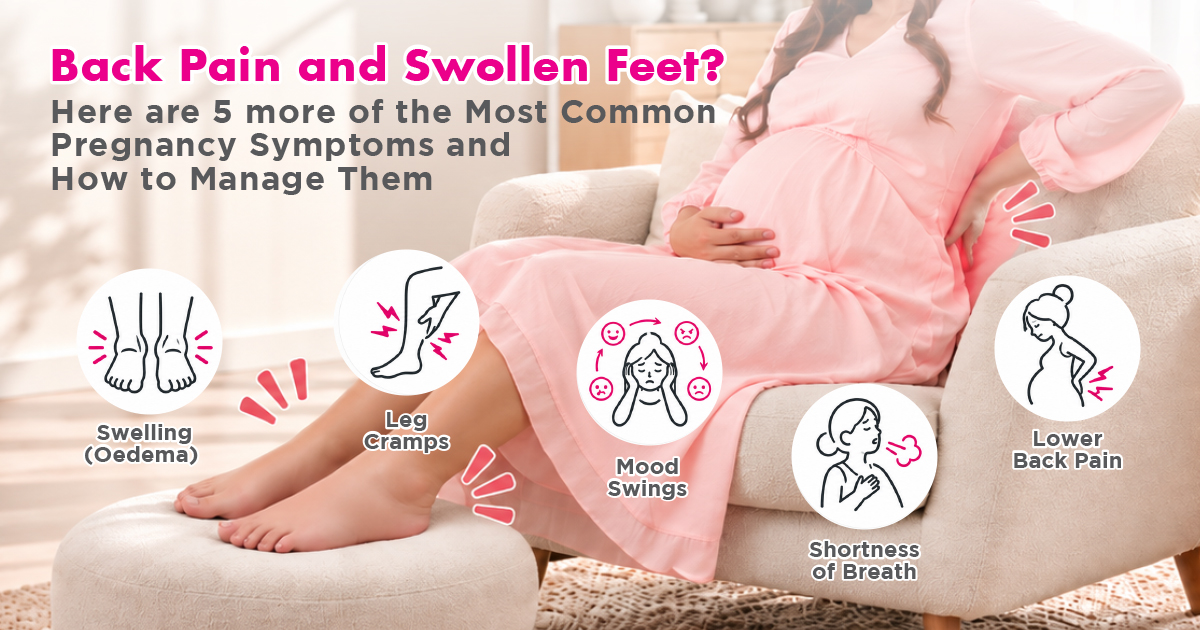
Pregnancy is an exciting and transformative journey, but it also comes with a range of physical and emotional challenges. It is quite normal to have a few discomforts throughout your pregnancy. To deal with them, we have put together some commonly experienced symptoms in pregnancy. The first part is in the article: “Feeling Nauseous, Fatigued and Constipated? Here are 5 of the Most Common Pregnancy Symptoms and How to Manage them”. This is the second part which is on another 5 of the most common pregnancy symptoms and how to deal with them. Being aware of all these symptoms can help expectant parents know when to self-soothe or when to call their doctor.
1: Lower Back Pain
Almost 70%[1] of pregnant women experience lower back pain during pregnancy especially in the 2nd and 3rd trimester. Lower back pain[2] during pregnancy is mainly caused by physical and hormonal changes. These include weight gain, a shifting centre of gravity that strains the spine, and the hormone relaxin[3] which loosens the ligaments connecting the pelvic bones to the spine. The heavy, growing uterus pulling forward, alters posture and increases the inward curve of the lower spine, adding extra pressure on the back. Stress and emotional tension can also tighten the back muscles.
Back pain related to pregnancy may continue up to three months after delivery. Also, women who have had back pain before pregnancy are twice as likely to suffer from this condition. The frequency of back pain increases with the age of the woman at the time of pregnancy and the number of pregnancies before this one.
How to Manage Back Pain
• Practice good posture and stand tall. Keep your shoulders relaxed, and avoid locking your knees
• When seated down, use a supportive chair.
• Sleep on your side with your knees bent. Put a pillow between your knees for better spinal alignment.
• Engage in prenatal stretches and exercises.
• Avoid heavy lifting. When picking something up, bend your knees and squat. Keep your back straight and use your legs to lift.
• Choose supportive shoes with low heels and good arch support. Avoid high heels or completely flat shoes.
2: Mood Swings
Mood swings[4] during pregnancy are normal and are primarily caused by a rapid surge in hormones like oestrogen and progesterone, which impact brain chemicals that regulate mood. Physical fatigue, body aches, morning sickness, and normal life stress or anxiety about becoming a parent also contribute heavily to these emotional shifts.
It’s worth noting that women who report premenstrual mood swings (PMS) tend to experience them during pregnancy, too. This study[5] also found a correlation between PMS and prenatal and postpartum depression, so be aware of your feelings.
How to Manage Mood Swings
• Get plenty of rest and reduce stress where possible.
• Take a break during the day to relax.
• Get regular physical activity. Exercise is a great stress reliever and mood booster.
• Eat well. If you’ve ever gotten “hangry,” you know that a lack of food can lead to an undesirable outburst.
• Spend time with loved ones.
• Take naps wherever possible.
• Engage in activities that bring you joy and relaxation.
• Don’t be so hard on yourself.
• Talk to supportive friends, family, or a therapist if needed.
• Practice deep breathing or prenatal meditation techniques.
3: Swelling (Oedema)
Mild swelling (oedema[6]) in the hands and feet is common during the later stages of pregnancy due to extra fluid production and pressure from the uterus, but sudden or severe puffiness — especially if accompanied by headaches, vision changes or upper stomach pain — can signal preeclampsia and requires immediate medical attention.
Oedema is caused by your body holding extra fluid and a 50% increase in blood volume to support your child, combined with the growing uterus pressing on your pelvic veins and slowing down blood flow back to the heart. Hormonal changes also relax blood vessel walls. This lets fluids leak more easily into nearby tissues. The fluid gathers in your lowest parts, like your feet and ankles, by the end of the day.
How to Manage Oedema
• Rest with your feet raised up higher than your hips for 15 to 20 minutes a few times a day
• Avoid standing or sitting still for a long time.
• Drink plenty of water to help your body flush extra fluid.
• Wear loose, comfortable shoes and clothes without tight bands.
• Sleep on your left side to take pressure off the large vein that returns blood to your heart.
• Move often and do simple ankle rolls or stretches if you sit for a long time.
• Eat potassium-rich foods like bananas to help balance fluid levels.
4: Shortness of Breath
Feeling short of breath during pregnancy is quite common, and usually isn’t a cause for concern. Shortness of breath[7] happens during pregnancy due to biological and mechanical changes relating to pregnancy. High levels of the hormone progesterone — which is also a respiratory stimulant — signal your brain to breathe deeper and faster, which can start as early as the 1st trimester. In fact, according to a 2015 study[8], an estimated 60–70% of women experience shortness of breath during pregnancy. Breathing might also get harder as your enlarging uterus takes up more space, putting pressure against your diaphragm (the muscle below your lungs) and leaving less room for your lungs to fully expand. Shortness of breath may also be caused by anaemia.
How to Manage Shortness of Breath:
• Stand up straight to give your lungs more space.
• Take slow, deep breaths to increase oxygen intake.
• Avoid overexertion and take breaks when needed.
• Sleeping with pillows supporting the upper back can allow gravity to pull the uterus down and give the lungs more space.
5: Leg Cramps
Leg cramps[9] during pregnancy are sudden, painful muscle contractions in the calves or feet that frequently strike during the 2nd and 3rd trimesters, often at night.
While doctors do not know the exact cause, leg cramps are often triggered by a mix of physical, circulatory, and nutritional changes. These cramps occur most frequently in your calf, feet or thigh. While in bed, stretch with your heels pointed, not your toes. This will help you to relieve a cramp.
Leg pain can sometimes be a sign of a blood clot. If the pain in your leg doesn’t go away, or if your leg is red, warm or swollen, see your doctor immediately.
How to Manage Leg Cramps:
• Stretch your legs before bed. Stretching before bed might help prevent leg cramps during the night.
• Drink plenty of fluids. Keeping your muscles hydrated might help prevent cramps.
• Ensure adequate calcium and magnesium intake.
• Massage the affected area and apply heat if needed.
• Wear the right shoes. Pick shoes that are comfortable and provide good support for your feet.
Mori-Mama
While pregnancy symptoms can be uncomfortable, many can be managed with lifestyle adjustments and home remedies. Remember, taking care of yourself during pregnancy is essential for both you and your child’s health.
One way of taking care of both you and your child’s health is by taking care of your changing nutritional needs. During pregnancy, nutritional needs change to support the growth of the foetus, develop the placenta, and expand the mother’s blood supply and body tissues.
Mori-Mama, which is Morinaga’s advanced maternal nutrition, supports these changes for both mother and child from the inside out. Formulated with 41 essential nutrients such as lactoferrin and iron and Synbiotic B. longum BB536 + FOS, it also contains vitamins and minerals notably iron, calcium, magnesium, and the whole range of B vitamins including folic acid ― the vitamin that makes healthy red blood cells and helps prevent serious brain and spine birth defects in the foetus. Mori-Mama delivers 349 µg of folic acid per serving — the highest among all the other brands of maternal milk in Malaysia.
If you’re feeling fatigued, some of the tiredness you feel may be attributed to hormones. However, fatigue may also be caused by anaemia. Anaemia is very common among women. It is a condition where the body has fewer red blood cells or less haemoglobin than normal which reduces the blood’s ability to carry oxygen to the organs and to the developing foetus. Iron is needed to make haemoglobin, the protein in red blood cells. During pregnancy, your body needs twice as much iron[10] to make extra blood for your child. This is especially so by the 3rd trimester when a woman’s blood volume increases by about 50% to support the growing child and prepare for childbirth.
Anaemia is a double-edged sword. While it causes you to be extremely fatigued, dizzy and out of breath, it can also hinder foetal brain and physical development[11] resulting in low birth weight, preterm birth, and even foetal heart failure.
You are usually given an iron supplement to correct your low iron count. However, these traditional supplements often cause gastrointestinal distress such as constipation, bloating, nausea and stomach cramps — which is the last thing you want.
Lactoferrin and Iron
Mori-Mama’s lactoferrin and iron can help you correct or prevent anaemia without the digestive side effects. Lactoferrin is a multifunctional, iron-binding protein found in high concentrations in mother’s milk especially colostrum. Like an iron bus that wraps around iron molecules and protects them from stomach acids, lactoferrin then transports the iron molecules across the intestinal wall to release them directly into the cells[12] of the body. This way, lactoferrin allows the body to absorb iron more efficiently and hence, prevent anaemia.
Mori-Mama delivers 22mg of Lactoferrin and 10mg of Iron per serving — the highest among all the other brands in Malaysia.
Synbiotic (B.longum BB536 + FOS)
Mori-Mama also contains Synbiotic (B.longum BB536 + FOS) — a combination of probiotic and prebiotic. The probiotic Bifidobacterium longum BB536[13] (B. longum BB536) is a Human-Residential Bifidobacteria (HRB) that is natively adapted to the human intestinal environment. Originally isolated from a healthy infant, B.longum BB536 has evolved to thrive in human body temperatures, and survive harsh gastric acid and bile.
Being able to survive and thrive in the human gut means the probiotic is able to provide sustained beneficial effects, delivering reliable support for your digestive and immune health. When digestion functions efficiently, the body is able to absorb and convert nutrients into energy more effectively.
In Mori-Mama, B. longum BB536 is paired with the prebiotic Fructo-Oligosaccharides (FOS) to form Synbiotic (B.longum BB536 + FOS). FOS is a natural fibre that is found abundantly in fruits and vegetables. FOS selectively feeds and grows the live cultures of B. longum BB536 to balance the gut microbiome, enhance nutrient absorption, and regulate the immune system. Clinical trials and research have shown that FOS can effectively soften stool and stimulate bowel movement[14] in pregnant mothers which helps to relieve constipation — one of the most common digestive problems experienced during pregnancy.
Mori-Mama provides 1.3 billion CFU of B. longum BB536 and 1.3g of FOS in every serving. It is also the only maternal milk brand in Malaysia to contain a HRB strain of probiotics.
Mori-Mama: A Trusted Heritage Brand
Mori-Mama is a trusted heritage brand with over 100 years of Morinaga innovation. It is a category leader in maternal milk nutrition that provides the one solution for moms from pregnancy planning to lactation. Not only is it formulated with revolutionary nutrients like Lactoferrin and Synbiotic B. longum BB536 + FOS, the milk only comes to you after a dual inspection process as every batch is first inspected at their manufacturing facility followed by a second inspection in Japan. This ensures you get uncompromising quality and safety. Mori-Mama has a mild vanilla flavour, doesn’t contain added sucrose and is certified halal.
[1] PubMed Central. (n.d.). Prevalence of low back pain during pregnancy. Retrieved from https://pmc.ncbi.nlm.nih.gov/articles/PMC10693090/
[2] Brown University Health. (n.d.). Back pain in pregnancy. Retrieved from https://www.brownhealth.org/centers-services/multidisciplinary-obstetric-medicine-service-moms/back-pain-pregnancy
[3] American Pregnancy Association. (n.d.). Back pain during pregnancy. Retrieved from https://americanpregnancy.org/pregnancy/back-pain-during-pregnancy/
[4] American Pregnancy Association. (n.d.). Mood swings during pregnancy. Retrieved from https://americanpregnancy.org/pregnancy/mood-swings-during-pregnancy/
[5] PubMed Central. (n.d.). Premenstrual syndrome and prenatal and postpartum depression. Retrieved from https://pmc.ncbi.nlm.nih.gov/articles/PMC4588839/
[6] NHS. (n.d.). Swollen ankles, feet and fingers in pregnancy. Retrieved from https://www.nhs.uk/pregnancy/common-symptoms/swollen-ankles-feet-and-fingers/
[7] Medical News Today. (n.d.). Shortness of breath during pregnancy. Retrieved from https://www.medicalnewstoday.com/articles/322316#overview
[8] Clinical Cardiology. (2015). Dyspnea in pregnancy. Retrieved from https://onlinelibrary.wiley.com/doi/epdf/10.1002/clc.22452
[9] WebMD. (n.d.). Leg cramps during pregnancy. Retrieved from https://www.webmd.com/baby/leg-cramps
[10] Yale Medicine. (n.d.). The importance of iron in pregnancy. Retrieved from https://www.yalemedicine.org/news/importance-of-iron-in-pregnancy
[11] PubMed Central. (2025). Complications of anemia in pregnancy: An updated overview for healthcare professionals. Retrieved from https://pmc.ncbi.nlm.nih.gov/articles/PMC12401385/
[12] Lactoferrin.co. (n.d.). How lactoferrin works in the body: Mechanisms explained. Retrieved from https://www.lactoferrin.co/blogs/articles/how-lactoferrin-works-in-the-body-mechanisms-explained
[13] Morinaga Milk Industry. (n.d.). Bifidobacterium longum BB536. Retrieved from https://morinagamilk-ingredients.com/probiotics/bb536/
[14] Express Healthcare. (n.d.). FOS and constipation: Examining the evidence for prebiotic supplementation. Retrieved from https://www.expresshealthcare.in/news/fos-and-constipation-examining-the-evidence-for-prebiotic-supplementation/438515/