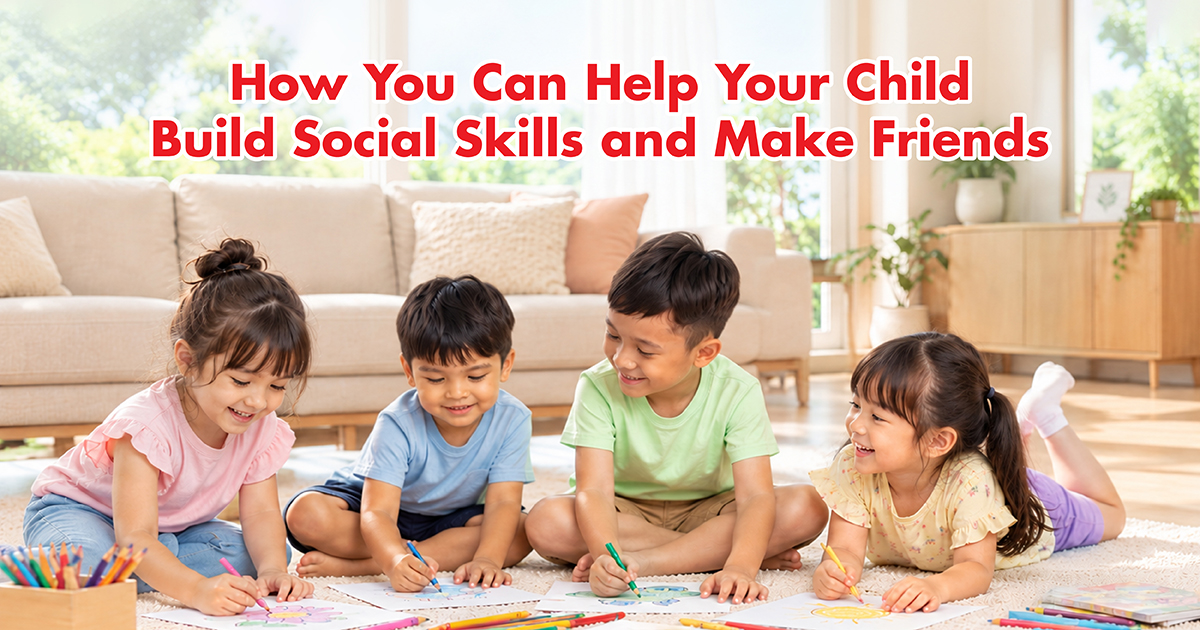
Friendships are very important to children. Having friends is not just a nice-to-have for kids but it improves their physical and mental health[1] and is a key part of growing up. Children generally start showing an interest in other children and making basic friends between 2 and 4 years old[2]. By age 3 when they go to playschool, children start talking, sharing toys, and interacting during playtime. By age 4, children begin true back-and-forth play, choose specific playmates they like, and start using shared rules or roles. By age 6 to 12, kids start building deeper, more meaningful friendships based on empathy, shared interests, and loyalty.
Friends provide emotional support and teach children empathy, compassion and to include others who are different. It’s a training ground for social skills. Kids learn how to resolve conflicts, behave in a group and respect each other. It also plays a role in building self-esteem and gives them a sense of belonging.
Yet, making friends isn’t always easy. After all, social skills don’t come naturally to everyone. Some kids may be shy and some may have the added challenge of hyperactivity or impulsivity. Respect their pace and remember that what may be easy for you may not be easy for them. Find ways to support their unique needs so they can eventually learn to manage friendships on their own.
If you notice your child having difficulty at making friends, what can you do as a parent to help your child with the ups and downs of friendships?
1: Start at home: Learning Relationship Skills
Making and keeping friends involves skills that are best learned at home with your family. Some of them include:
• Active Listening: Focus completely on the person speaking instead of just planning your reply. Make eye contact and ask follow-up questions[3] to show you truly understand.
• Empathy: Make sure that everyone in the family treats each other fairly and with kindness. Sometimes we turn a blind eye to sibling fights, or feel justified in snapping at our spouse when we have had a long day. No matter what we say, our children pay attention to what we do. Teach yourself and others to see situations from another person’s point of view.[4]
• Cooperation and Sharing: Practice taking turns during family games, sharing snacks, or working chores together. Help your child learn about taking turns and valuing the input of others.
• Conflict Resolution: Address disagreements calmly and fairly[5] rather than ignoring them. Learn how to apologize when you make a mistake and forgive others.
• Communication skills: Make it a habit to talk about each other’s days, interests, and feelings. Family dinners without the distraction of devices can foster better communication skills. These conversations can teach your child to be curious about others, reflect on how they handled social situations, and express themselves clearly.
• Setting boundaries: Respect personal space and accept “no” for an answer. Clear limits help build mutual trust.
• Curiosity about others: Make a family habit of asking each other about their day, their interests, and their thoughts.
• Regulating emotions: It’s normal to have strong feelings such as anger, fear, frustration, sadness, and overwhelming excitement. When your child does have them, help them find ways to understand these big emotions and manage them.
All of these also apply to how you and your partner talk about ― or with ― other people in front of your children, too. Remember that children are always observing and will copy what you do.
2: Teach Social Skills
• Practice conversation starters: Help your child learn how to say hello, ask for someone’s name, or invite another child to play.
• Encourage active listening: Teach your child to look at the person speaking, wait their turn, and not interrupt.
• Teach the art of conversation: Many children love sharing their ideas but need support learning how to keep the conversations going. Encourage them to ask questions, listen without interrupting, respond to what someone else has said, and show interest in another person’s ideas.
3: Be a Good Role Model Outside the Home, too
When you are outside your home, be friendly by demonstrating respectful everyday interactions[6], polite manners, and calm conflict resolution in public places where children can observe them. Say hello to store clerks, cashiers, and neighbours so your child sees friendly communication.
4: Create Opportunities to Make interactions Easier
Conversations and interactions can be easier if they are organised around a common interest or activity. Here are some ways parents can help:
• Sign your child up for sports, martial arts, art classes or community clubs or other activities that involve their peers. Make sure it’s something they have some interest in doing.
• Get to know the parents of some of your child’s peers ― and invite them all to an outing or meal. It could allow the children to get to know each other while taking some of the pressure off.
• Look for kids in your neighbourhood or school who live close by to make regular contact easier.
• Set up playdates by arranging small, low-pressure get-togethers at your home, keeping the first visits small and short. Think about fun, cooperative activities like building blocks, baking, art, or outdoor games that naturally encourage conversation and cooperation.
5: Keep an Eye on your Child But don’t Hover
Ultimately, your child needs to learn to make friends by themselves ― and you don’t want to embarrass them, either. The two exceptions might be:
• If the children aren’t interacting at all, you might want to suggest some options for activities. Facilitate as necessary, and step back out again.
• If there is fighting or meanness on either side, you should step in and make it clear that such behaviour isn’t okay.
6: If your Child keeps Struggling with Making Friends, Talk to your Doctor
All parents need help sometimes ― and sometimes there is more to the problem than meets the eye. This is particularly true if your child has ADHD or another diagnosis that could make interactions more challenging. Children with ADHD often struggle to make and keep friends because core symptoms like impulsivity, inattention, and emotional dysregulation interfere with normal social back-and-forth.
7: Praise Positive Social Actions
Acknowledge positive social actions immediately by using specific praise[5] that names the exact kind behaviour you saw. For example, say, “Thank you for sharing your blocks” instead of a vague “Good job.” And connect the action to the friend’s reaction so they see the impact.
Morinaga Chil-kid
It may not seem as if nutrition plays a role in making friends but the opposite is true. Good nutrition can help children make friends by supporting the moods, energy levels, and social behaviours needed for positive peer interactions. Good nutrition reduces irritability and tantrums. One way to ensure your child gets all the nutrition he needs everyday is by giving him balanced meals. Pair this with growing up milk such as Morinaga Chil-kid which has been formulated with 45 carefully-balanced nutrients. Chil-kid has two formulations.
Chil-kid Step 3
Chil-kid Step 3 is a science-based, nutrient-dense milk formula that is specially made for children in the 1 to 3 years bracket. Children in this age group require the right nutrients as they experience significant development in physical, cognitive, and social-emotional areas, reaching milestones like walking, talking, listening and showing interest in social interactions.
Chil-kid Step 4
Chil-kid Step 4 is the formula for preschoolers and school-going children in the 3+to 9-years age group. Chil-kid Step 4 is developed based on Chil-kid Step 3 but is further enhanced to meet the evolving needs of growing children. Children in this age group are in their Golden Age of Growth. With their changing nutritional needs that come along as they age, Chil-kid Step 4’s DHA, ARA, inositol and choline provide the nutrients to facilitate continued brain connections and growth.
Chil-kid Step 3 and Chil-kid Step 4
Both Chil-kid Step 3 and Chil-kid Step 4 are designed to be one continuous journey of growth and development for the child. Both formulas do not contain sucrose and are specially formulated with optimised nutrition for Asian children according to their age groups and nutritional needs.
Morinaga Chil-kid is the result of over 100 years of child nutrition research by Japanese scientists. Everything in both formulations is backed by research and all nutrient combinations are tested and refined by the Morinaga R&D Institute in Japan.
Wholly produced from dairy farms to the packaging process in a state-of-the-art plant in the Netherlands, both milk formulas go through rigorous European Union (EU) quality control as well as a double inspection process with samples sent to Japan for a second inspection before they are shipped to Malaysia.
[1] News-Medical. (2026). Strong friendships linked to better mental and physical health. Retrieved from https://www.news-medical.net/news/20260813/Strong-friendships-linked-to-better-mental-and-physical-health.aspx
[2] Sparkling Seeds. (n.d.). How to support your child as they build their first friendship. Retrieved from https://sparklingseeds.com/how-to-support-your-child-as-they-build-their-first-friendship/
[3] YouTube. (n.d.). Active listening skills [Video]. Retrieved from https://www.youtube.com/watch?v=39tBMv6xWBU
[4] Child Mind Institute. (n.d.). Teaching social skills at home. Retrieved from https://childmind.org/article/teaching-social-skills-at-home/
[5] Total Communication. (n.d.). 8 everyday ways parents can support social skills at home. Retrieved from https://www.totalcommunication.com.sg/post/8-everyday-ways-parents-can-support-social-skills-at-home
[6] St Martin’s Academy. (n.d.). How to encourage good social skills. Retrieved from https://stmartinsacademy.org.uk/how-to-encourage-good-social-skills/